How to Create a Toddler Daily Routine (Free Printable Schedule)
It was 4:47 p.m. My toddler was face down on the kitchen floor, crying because his banana broke in half.
He had skipped his nap. Lunch happened at 1:30 instead of noon. And somewhere between the grocery run and the surprise playdate, our whole day fell apart.
Here is the strange part. Nothing about that day was bad. It was just unpredictable. And for a toddler, unpredictable feels a lot like chaos.
That was the week I finally sat down and built a real toddler daily routine. Not a rigid, minute-by-minute timetable. A simple rhythm our family could actually follow. Within two weeks, naps got easier, meals got calmer, and bedtime stopped feeling like a negotiation.
In this guide, I will walk you through exactly how to create a routine that fits your child and your life. You will find sleep needs by age, a step-by-step method, sample schedules for 12 months to 3 years, troubleshooting tips, and a free printable schedule you can stick right on the fridge.
Let’s build your day.
Why a Daily Routine Matters for Toddlers
Toddlers have very little control over their world. A predictable routine gives them a sense of safety, because they know what comes next. That security shows up in better behavior, easier transitions, and more cooperative days.
Here is what a consistent routine can do for your little one (and for you):
- Better sleep. Regular wake times, nap times, and bedtimes help set your child’s internal body clock, so falling asleep gets easier.
- Fewer tantrums. Many meltdowns come from hunger, tiredness, or surprise. A routine heads off all three.
- Smoother transitions. When bath always follows dinner, your toddler stops fighting bath time. It is simply “what we do next.”
- Growing independence. Toddlers who know the order of their day start doing steps on their own, like grabbing their shoes before going outside.
- Calmer parents. You stop making a hundred small decisions every day. The routine makes them for you.
Routine vs. schedule: what’s the difference?
A schedule is tied to the clock: lunch at 12:00, nap at 12:45. A routine is tied to order: lunch, then books, then nap. Most families do best with a routine that has a few anchor times (wake-up, nap, bedtime) and flexible blocks in between. That way a late breakfast does not throw off your entire day.
How Much Sleep Does a Toddler Need?
Sleep is the backbone of any toddler routine, so start here. The American Academy of Pediatrics recommends 11 to 14 hours of total sleep (including naps) for children aged 1 to 2, and 10 to 13 hours for ages 3 to 5. Use the table below as a starting guide, then adjust for your own child.
Age | Total sleep (24 hrs) | Naps per day | Typical awake window |
|---|---|---|---|
12 to 15 months | 11 to 14 hrs | 2 (some move to 1) | 3 to 4 hrs |
15 to 18 months | 11 to 14 hrs | 1 | 4 to 5 hrs |
18 to 24 months | 11 to 14 hrs | 1 | 5 to 6 hrs |
2 to 3 years | 11 to 14 hrs | 1 (1 to 2 hrs long) | 5 to 6 hrs |
3 years+ | 10 to 13 hrs | 0 to 1 (or quiet time) | 6+ hrs |
Quick tip: Most toddlers move from two naps to one somewhere between 12 and 18 months. Signs your child is ready include fighting the second nap, taking a long time to fall asleep, or bedtime getting pushed later and later.
Every child is different. If your toddler wakes up happy and stays fairly cheerful through the day, they are probably getting enough sleep, even if the numbers look a little different.
How to Create a Toddler Daily Routine in 7 Simple Steps
You do not need to overhaul your whole life to build a routine that works. Follow these seven steps, and you will have a working plan by the end of the week.
Step 1: Track your toddler’s natural rhythm for 3 days
Before you change anything, watch. For three days, jot down when your child wakes up, eats, naps, gets cranky, and falls asleep at night. You will usually spot a natural pattern already forming. Your routine should build on that pattern, not fight it.
Step 2: Set your anchor times
Pick three fixed points for the day:
- Wake-up time (keep it within a 30-minute window every day, weekends included)
- Nap time (based on your child’s awake window from the table above)
- Bedtime (count back from wake-up time using your child’s sleep needs)
These three anchors hold the whole day together. Everything else can flex around them.
Step 3: Schedule meals and snacks
Most toddlers do well with three meals and two snacks, spaced about 2 to 3 hours apart. Regular meal times keep hunger meltdowns away and make it easier for your child to eat well at the table instead of grazing all day.
Step 4: Add active play and outdoor time
Toddlers need to move. Plan at least one block of active play every morning and every afternoon. Outdoor time, even 20 minutes in the backyard, helps burn energy and often leads to better naps.
Step 5: Include quiet and connection time
Balance busy blocks with calm ones: reading books, puzzles, playdough, or cuddling on the couch. These quieter moments help your toddler reset, and they are often the best part of the day for both of you.
Step 6: Build simple routines inside the routine
The biggest wins come from small, repeated sequences. For example:
- Morning: wake up, diaper or potty, get dressed, breakfast
- Pre-nap: lunch, wash hands, one book, sleep sack, lights off
- Bedtime: dinner, bath, pajamas, brush teeth, two books, song, lights out
Keep these sequences the same every day. Your toddler will learn them faster than you think.
Step 7: Make it visual
Toddlers cannot read a clock, but they can read pictures. A picture-based schedule on the wall lets your child “see” what comes next. This is where the free printable below comes in handy.
Sample Toddler Schedules by Age
Use these sample schedules as a starting point. Shift every time earlier or later to match your child’s wake-up time.
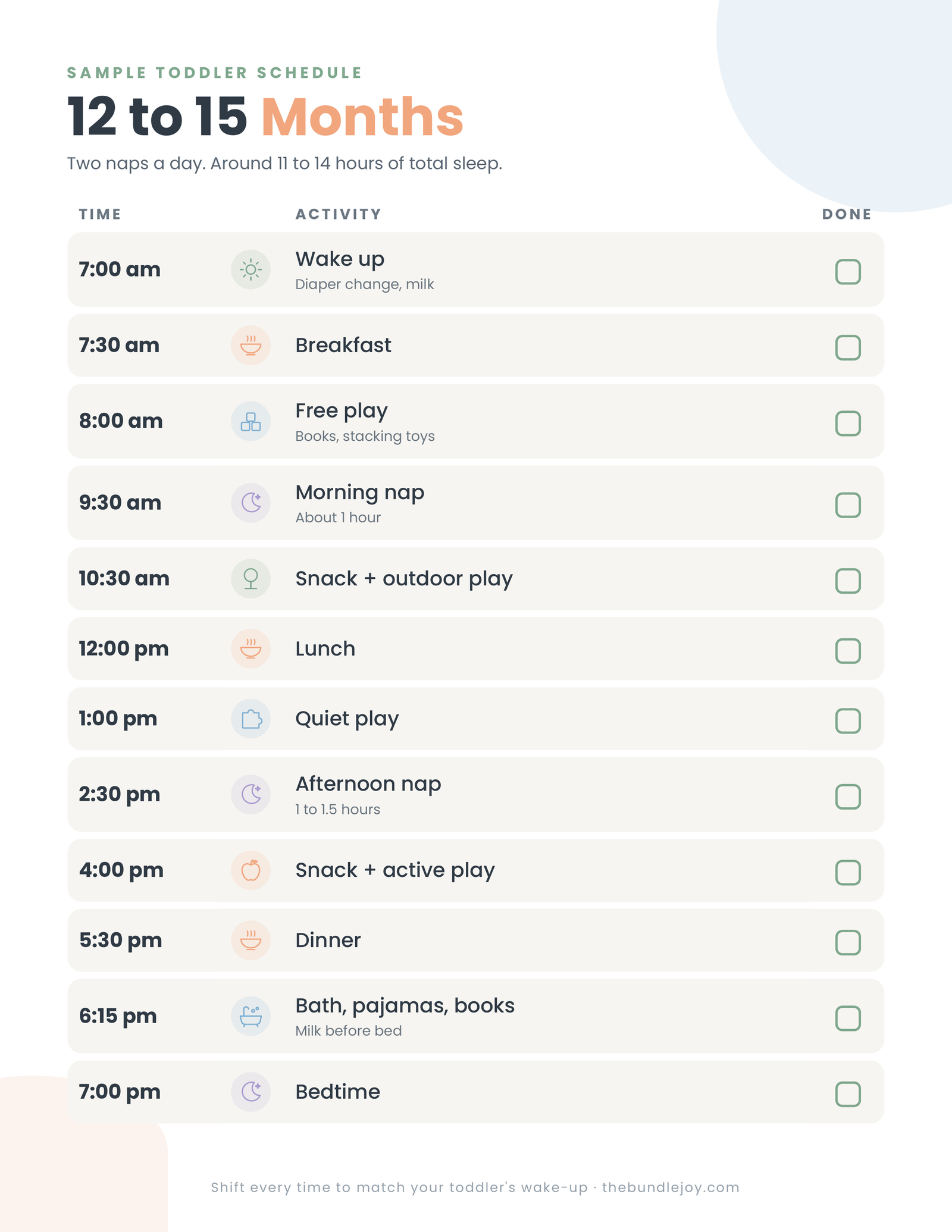
Sample schedule: 12 to 15 months (two naps)
Time | Activity |
|---|---|
7:00 a.m. | Wake up, diaper change, milk |
7:30 a.m. | Breakfast |
8:00 a.m. | Free play, books |
9:30 a.m. | Morning nap (about 1 hr) |
10:30 a.m. | Snack, outdoor play |
12:00 p.m. | Lunch |
1:00 p.m. | Quiet play |
2:30 p.m. | Afternoon nap (1 to 1.5 hrs) |
4:00 p.m. | Snack, active play |
5:30 p.m. | Dinner |
6:15 p.m. | Bath, pajamas, books, milk |
7:00 p.m. | Bedtime |
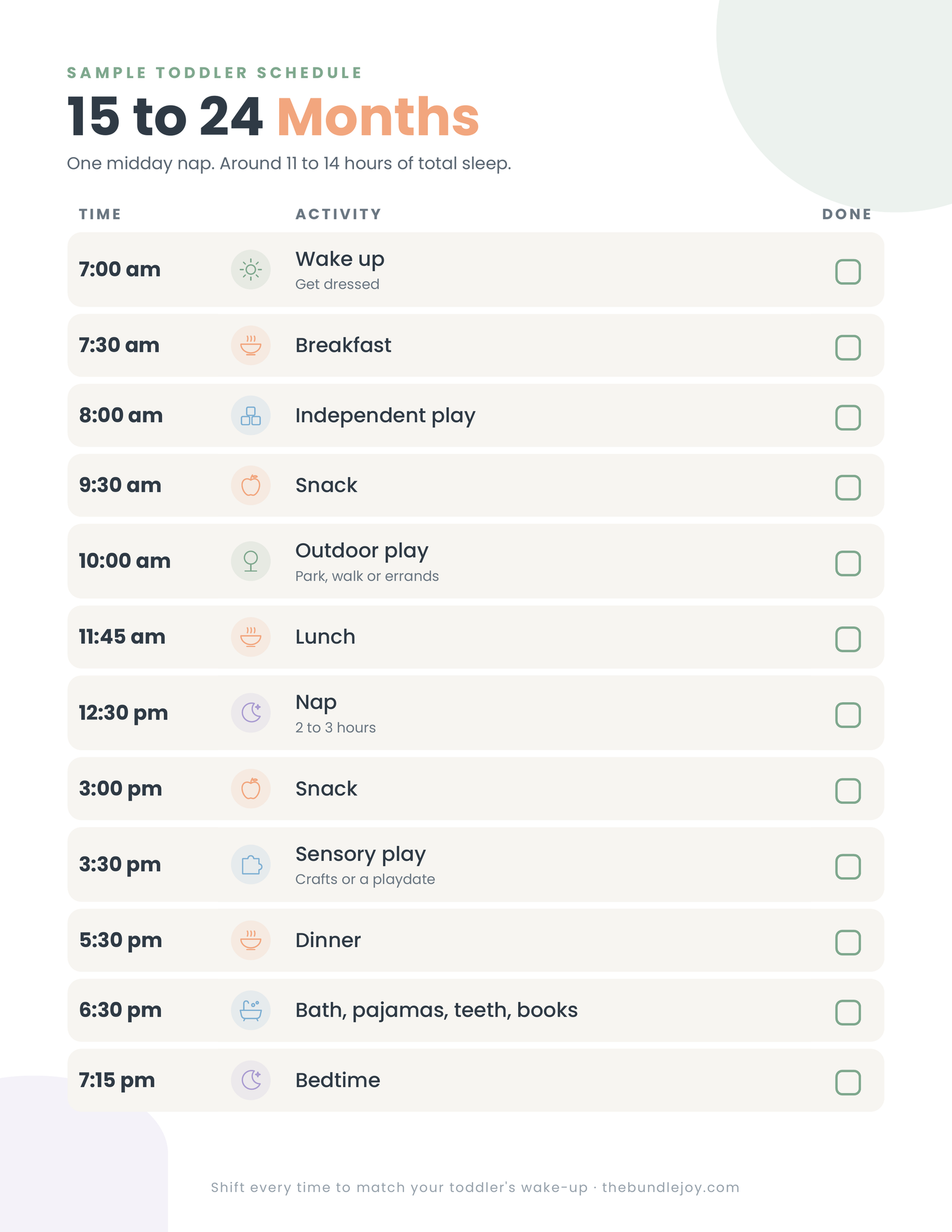
Sample schedule: 15 to 24 months (one nap)
Time | Activity |
|---|---|
7:00 a.m. | Wake up, get dressed |
7:30 a.m. | Breakfast |
8:00 a.m. | Independent play |
9:30 a.m. | Snack |
10:00 a.m. | Outdoor play, park, or errands |
11:45 a.m. | Lunch |
12:30 p.m. | Nap (2 to 3 hrs) |
3:00 p.m. | Snack |
3:30 p.m. | Sensory play, crafts, or a playdate |
5:30 p.m. | Dinner |
6:30 p.m. | Bath, pajamas, teeth, books |
7:15 p.m. | Bedtime |
Sample schedule: 2 to 3 years
| Time | Activity |
|---|---|
7:00 a.m. | Wake up, potty, get dressed |
7:30 a.m. | Breakfast |
8:00 a.m. | Help with simple chores (put away toys, feed a pet) |
8:30 a.m. | Learning play: puzzles, blocks, pretend play |
10:00 a.m. | Snack |
10:30 a.m. | Outdoor play or an outing |
12:00 p.m. | Lunch |
12:45 p.m. | Nap or quiet time (1 to 2 hrs) |
3:00 p.m. | Snack |
3:30 p.m. | Art, music, or a playdate |
5:00 p.m. | Help prep dinner, free play |
5:30 p.m. | Dinner |
6:30 p.m. | Bath, pajamas, teeth, books |
7:30 p.m. | Bedtime |
Sample schedule: working parents and daycare days
If your toddler goes to daycare, you only own the mornings and evenings. Keep those parts rock solid.
Time | Activity |
|---|---|
|
|
6:50 a.m. |
|
|
|
| Pick-up, snack in the car |
6:00 p.m. | Dinner |
6:30 p.m. | Play and connection time (phones away) |
7:00 p.m. | Bath, pajamas, books |
| Bedtime |
Tip: Ask your daycare for their daily schedule and copy their nap and meal times on weekends. Your toddler’s body clock will thank you on Monday.
Free Printable Toddler Daily Schedule
Ready to put your plan on paper? Our free printable toddler schedule comes in three versions, so you can pick the one that fits your family best.
What’s included in the free download:
- Fill-in-the-blank daily schedule. Write your own times and activities. Perfect for customizing.
- Pre-filled sample schedules. Ready-to-use versions for 12 to 15 months, 15 to 24 months, and 2 to 3 years.
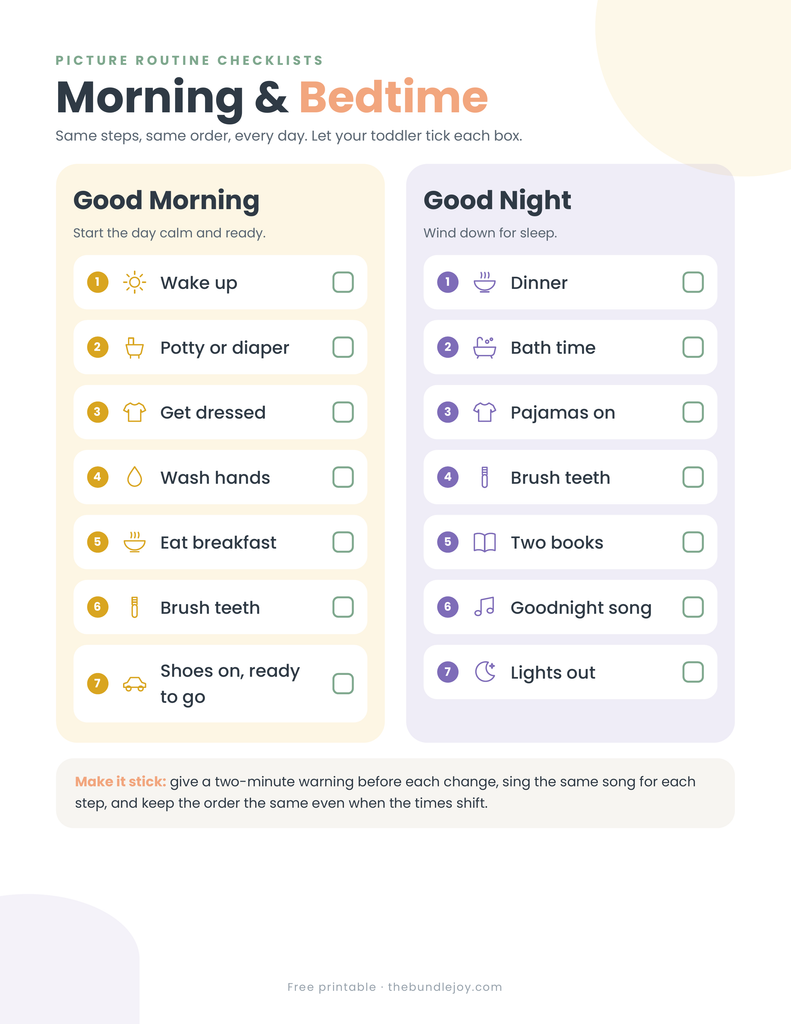
- Picture routine cards. Cut-out cards with simple icons (wake up, breakfast, play, nap, bath, bedtime) that toddlers can follow on their own.
[Download your free printable toddler schedule here]
Free Printable Toddler Daily Schedule
Ready to put your plan on paper? Our free printable toddler schedule is a 6-page pack sized for standard US Letter paper (8.5 x 11 inches), so you can pick the pages that fit your family best.
What’s included in the free download:
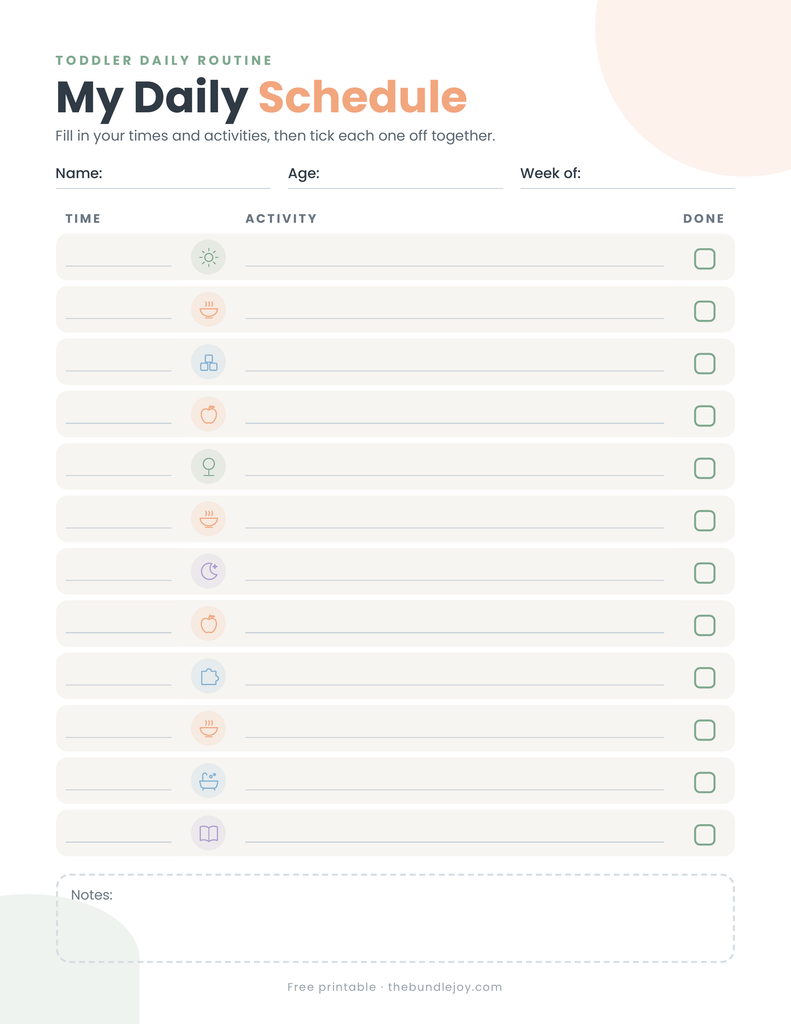
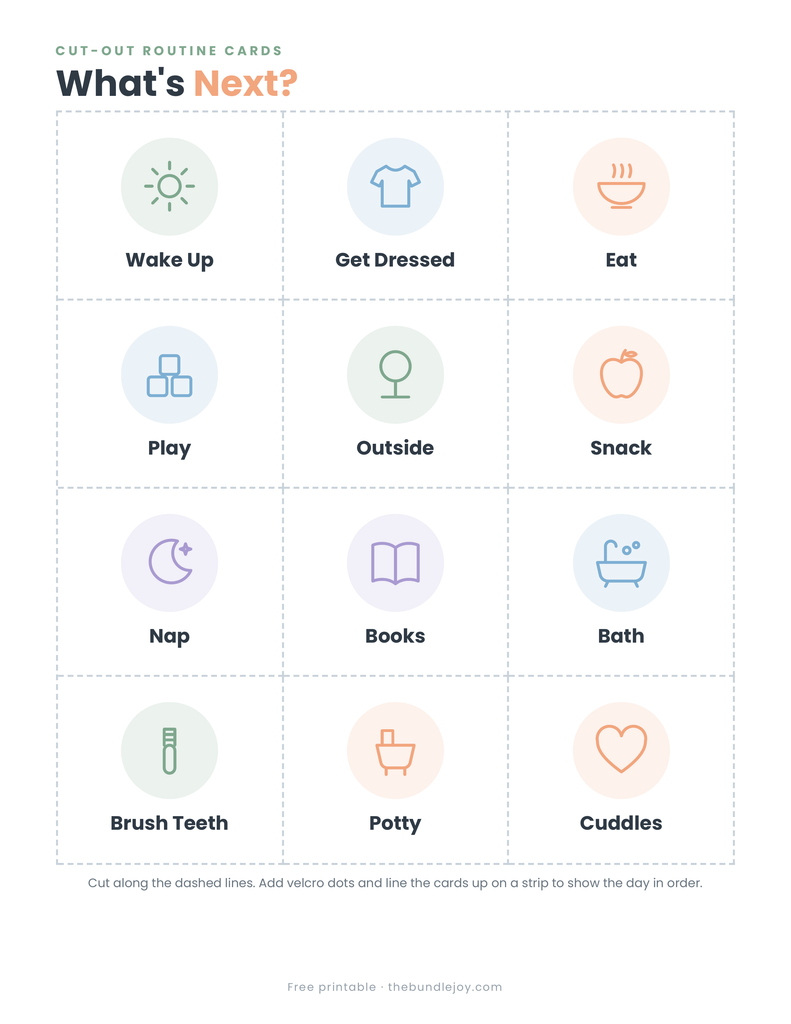
- Page 1: My Daily Schedule. A fill-in-the-blank schedule with 12 picture rows, tick boxes, and space for notes.
- Pages 2 to 4: Sample schedules. Ready-to-use versions for 12 to 15 months, 15 to 24 months, and 2 to 3 years.
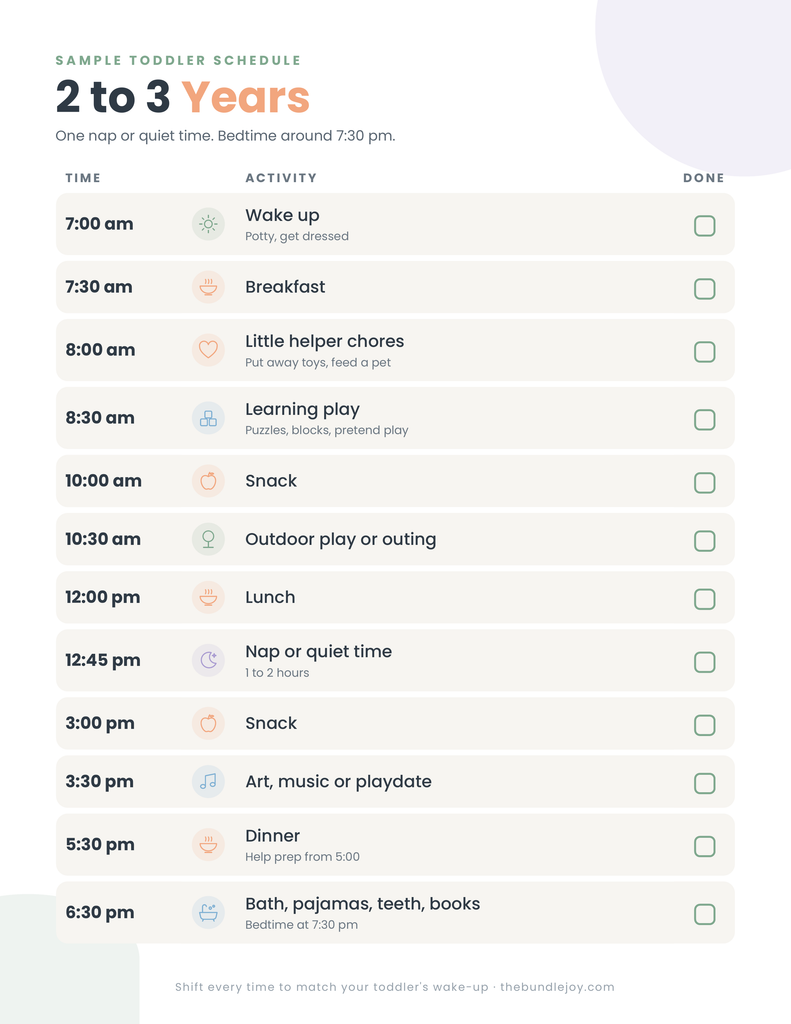
- Page 5: Morning and bedtime checklists. Seven picture steps each that your toddler can tick off.
- Page 6: Cut-out routine cards. Twelve picture cards (wake up, eat, play, nap, bath, books and more) to line up in order.
[Download your free printable toddler schedule here]
The printable pages
Each page below is a full-size, print-ready sheet (8.5 x 11 inches at 300 dpi). Click a page to open it full size, then print at 100% scale or “Fit to page.”
Page 1: My Daily Schedule (fill-in-the-blank)
Page 2: Sample schedule for 12 to 15 months
Page 3: Sample schedule for 15 to 24 months
Page 4: Sample schedule for 2 to 3 years
Page 5: Morning and bedtime routine checklists
Page 6: Cut-out routine cards
Fill-in-the-blank template
Fill-in-the-blank template
Prefer to make your own? Copy this simple template into a notebook or print it as is.
Time | Activity | Done |
|---|---|---|
______ | Wake up | |
______ | Breakfast | |
______ | Morning play | |
______ | Snack | |
______ | Outdoor time | |
______ | Lunch | |
______ | Nap or quiet time | |
______ | Snack | |
______ | Afternoon play | |
______ | Dinner | |
______ | Bath and pajamas | |
______ | Books and bedtime |
How to use your printable
- Print on cardstock so it lasts longer, or slide it into a sheet protector.
- Fill in your anchor times first (wake-up, nap, bedtime), then add the rest.
- Hang it at your toddler’s eye level, like on the fridge or near their bedroom door.
- Use a dry-erase marker or a magnet to point to “what we’re doing now.”
- Let your toddler move the magnet or tick off each step. Kids love the sense of accomplishment.
10 Tips to Make Your Toddler’s Routine Stick
Creating the routine is the easy part. Sticking with it is where the magic happens. These tips will help.
- Start small. Begin with just the bedtime routine. Once that clicks, add mornings, then naps.
- Give it two weeks. Toddlers need time to adjust. Do not judge a new routine after two rough days.
- Use transition warnings. Say “Two more minutes, then it’s bath time.” A visual timer works even better.
- Sing your way through. A clean-up song or a tooth-brushing song turns transitions into games.
- Offer limited choices. “Do you want the blue pajamas or the dinosaur pajamas?” gives control without changing the plan.
- Keep weekends close. Try to stay within an hour of weekday wake and sleep times.
- Get everyone on board. Share the printable with your partner, grandparents, and babysitters so the routine stays the same no matter who is in charge.
- Protect the nap. Plan errands and outings around nap time whenever you can.
- Build in buffer time. Toddlers move slowly. Add 10 to 15 minutes to every transition so you are not rushing.
- Stay flexible. Teething, travel, and growth spurts will throw you off. That is normal. Just return to the routine as soon as you can.
Common Toddler Routine Problems (and How to Fix Them)
Even the best routine hits bumps. Here are the most common ones and what to try.
Problem | Likely cause | What to try |
|---|---|---|
Fights the nap | Awake window too short, or ready to drop a nap | Push nap 15 to 30 minutes later; watch for nap transition signs |
Wakes up too early | Bedtime too late (overtired) or room too bright | Try an earlier bedtime and blackout curtains |
Bedtime takes forever | Too much screen time or play right before bed | Turn off screens an hour before bed; keep the bedtime routine calm and short |
Meltdowns late afternoon | Hunger or a long stretch since nap | Add a protein-rich snack around 3:30 to 4:00 p.m. |
Refuses to leave the park | Sudden transitions | Give a 5-minute warning and a “last slide” countdown |
Routine falls apart on weekends | Late nights and changing plans | Keep wake-up and nap within an hour of weekday times |
If sleep or behavior problems continue for weeks, or you notice your child seems unusually tired, check in with your pediatrician. They can rule out issues like ear infections or sleep apnea.
Toddler Daily Routine FAQs
What time should a toddler go to bed?
Most toddlers do best with a bedtime between 6:30 and 8:00 p.m. The right time depends on when your child wakes up and how long they nap. Count back 11 to 12 hours from their usual wake-up time for a good starting point.
How long should a toddler nap?
Once toddlers move to one nap, it usually lasts 1.5 to 3 hours. By age 3, many children nap for about 1 to 2 hours, and some stop napping altogether.
When should I start a routine with my toddler?
You can start at any age. Even babies benefit from simple routines like a consistent bedtime sequence. If you are starting now with a toddler, begin with bedtime and build from there.
What if my toddler refuses to follow the routine?
That is completely normal, especially in the first week. Stay calm and consistent, use transition warnings, and offer small choices within each step. Most toddlers settle into a new routine within one to two weeks.
How much screen time is okay in a toddler routine?
The American Academy of Pediatrics suggests avoiding screens (other than video chatting) for children younger than 18 to 24 months. For ages 2 to 5, it recommends limiting screen time to about 1 hour a day of high-quality programming, ideally watched together.
Should my toddler’s routine be the same every day?
The order of events should stay mostly the same, but the exact times can flex. Aim to keep wake-up, nap, and bedtime consistent, and let the rest of the day breathe.
Final Thoughts
A toddler daily routine is not about being perfect. It is about giving your child a predictable rhythm so they feel safe, rested, and ready to explore. Start with your anchor times, build small repeatable sequences, and make it visual with the free printable.
Some days will go off the rails. That is okay. The routine will be right there waiting for you tomorrow.
Download your free printable toddler schedule, stick it on the fridge, and enjoy calmer days ahead. And if this guide helped, save it to your Pinterest parenting board so you can find it again